Prop firm or your own account?
Prop trading firms have become hugely popular, particularly among people trading futures contracts. We don't point to any specific firm or model – below you'll find criteria that make it easier to decide for yourself.
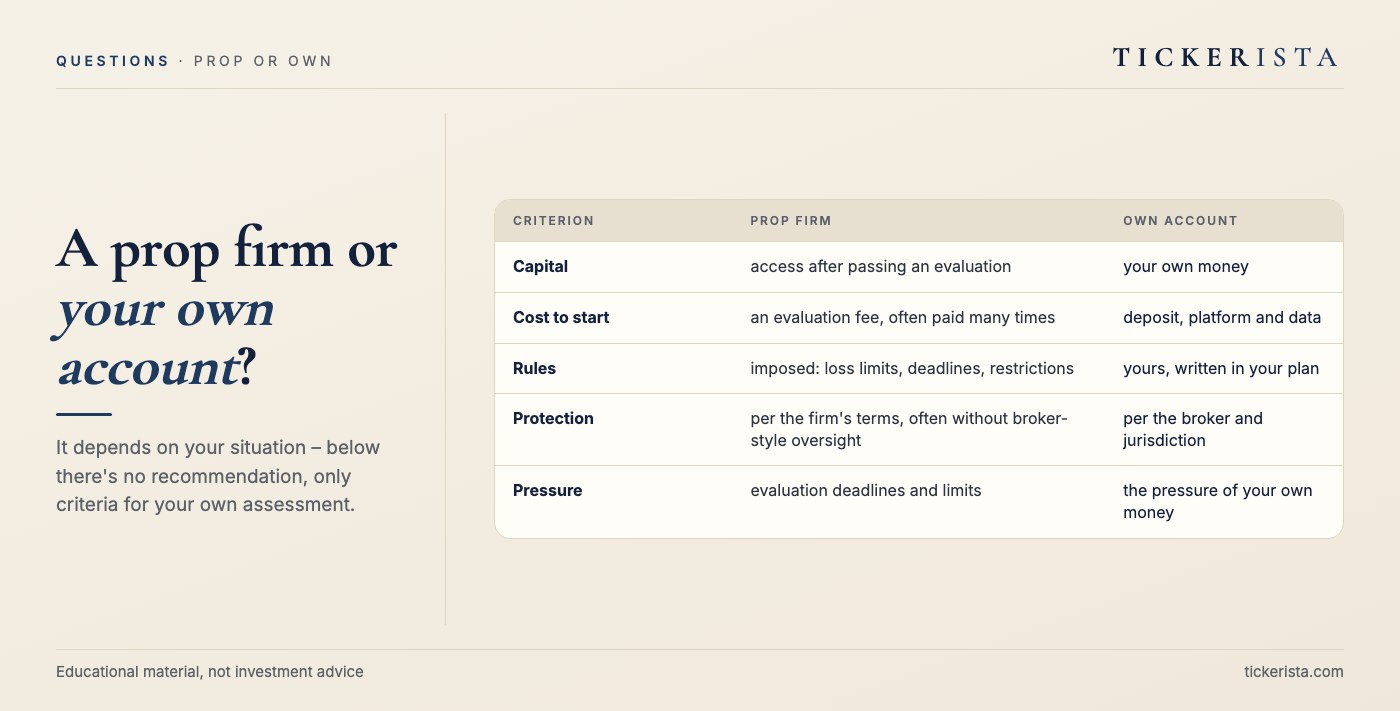
How they compare
- Capital: with a prop firm, you receive it from the firm once you pass the evaluation; in your own account you trade your own money.
- Cost of entry: with a prop firm you pay for the evaluation, and after failing it you often pay again. Your own account means the margin deposit plus spending on the platform and data.
- Rules: a prop firm sets loss caps, deadlines and restrictions, for instance no trading around data releases. In your own account, what applies is what your plan says.
- Protection: with a prop firm it is defined by its terms of service, and such firms often aren't overseen like brokers. In your own account, your broker and the jurisdiction determine it.
- Pressure: evaluation deadlines and limits on one side, the weight of risking your own money on the other.
What to check in a prop firm's terms
- the way drawdown is measured (e.g. fixed or trailing)
- withdrawal rules and how profits are shared
- the list of forbidden practices and trading hours
- the consequences for the account of breaking the rules
The common rule
No matter what you choose, the process stays the same: a plan, a journal, regulating your state and consistency. No prop firm can stand in for skill, and its limits call for discipline to an even greater degree.
Details in the 📖 Trader's Glossary, entry: Prop trading firm.
Educational content, not financial, legal or tax advice.
Tickerista Terminal: order flow tools
Liquidity heatmap, DOM, footprint, Volume Profile, TPO and cumulative delta – the same kind of tools as in Sierra Chart, ATAS or Bookmap. In the browser you practise on the Tickerista Index (TIX); on the real market you work in the Windows and Mac app, on your own data. See screenshots of every tool →
The Tickerista Terminal is part of the club: live for Dow Jones from the Tape Reader plan, 6 markets (Dow Jones, S&P 500, Nasdaq, gold, crude oil, Bitcoin) and automatic detection of order flow events from the Big Board plan. A session on the Tickerista Index (training, simulated data) in the full panel comes with the Ticker plan and above. Compare the plans →